

Congratulations! If you’re reading this, you’ve probably been asked to feature in a business case study video.
This guide explains the basics so you can feel comfortable on the filming day and know what to expect from our video production team.
What is a case study video?
A case study video shows how you, as the customer, use and benefit from a business’s products or services.
The ‘customer’ might be an individual or someone representing another business. In sales terms you may be familiar with these being called Business-to-Consumer (B2C) and Business-to-Business (B2B).
As an example, a case study might be about a person using and benefiting from a community service. Or, it could be how a manufacturing company helps another business to succeed with a special service or product.
The goal of a case study video is to help businesses share real customer experiences and build trust with future customers.
By sharing your experience, you’ll help people see how the business makes a real difference.
It’s a great opportunity to tell your story too!
It might sound like it’s all about promoting the business – but it’s also a chance to tell your own story.
A well-made case study video will allow you to talk about your story / business and the success you’re having. You’ll often be able to use the finished video on your own socials or website for promotional purposes.
At Storylight, we offer special ‘repurposed customer edits’ that are focused just on you. We think everyone involved should get as much value from the filming day as possible. Talk to the business arranging the video if this is possible, or enquire here for more information.
Working with our expert video production team
At Storylight, we specialise in making case study videos with people who’ve never been on camera before.
Our goal is to help you be yourself and share your experience naturally. On the filming day our one or two person crew will guide you through everything you need to know.
Filming your interview and B-roll
To make the video look great it’s important everyone involved has a basic understanding of the process.
The shoot day will consist of two main stages: the interview and the B-roll.
Usually, we film the interview first, as that will take us time to set up before you arrive on location.
After the interview we’ll film the B-roll – the supporting footage of you in different locations, interacting with people, or doing your everyday work.
Simple tips for being interviewed in a case study
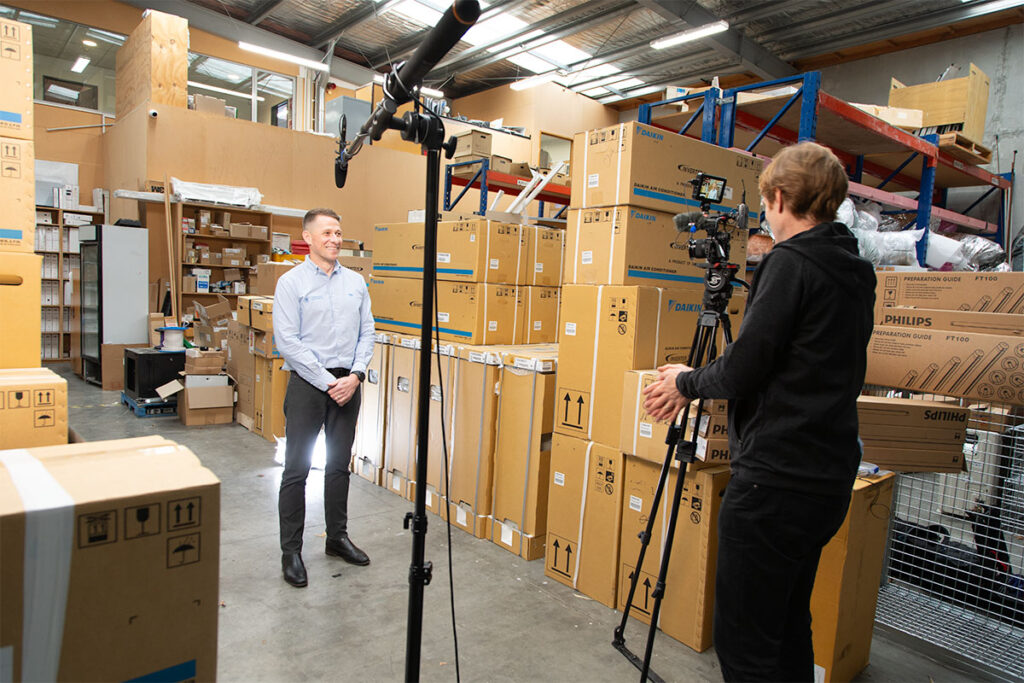
On the day of the shoot, our team will guide you through the whole process.
Our interviewer will ask you the questions. The most helpful thing you can do is summarise the question in your answer. For example, if we asked, “What’s your favourite colour?” you would reply, “My favourite colour is blue.” Rather than simply answering, “Blue.”
There are no right or wrong answers. So don’t worry if you stumble over your words, we’ll simply ask the question again.
How to act naturally on video
We want to capture the best possible B-roll footage to tell your story, so we may ask you to do some ‘acting’.
Before you panic… ‘acting’ simply means repeating everyday actions a few times so we can capture them from different angles.
For example, we may need a shot of you walking into a business reception area. This could be an important shot to open the video, so we’d film it a few times and capture different angles that can be edited together in the final video.
The more you can be yourself, the better the video will look. Try to forget the camera is there and imagine how you’d naturally behave and relate to people in that location.
What should you wear?
Modern cameras are much more forgiving of what you can wear on camera. Here are the do’s and don’ts of how to dress for a video shoot.
- Our general guideline is to avoid large slogans or logos. (unless it’s relevant for music, art etc.)
- Dress in what makes you look great and feel comfortable. If your role is the CEO then a suit or shirt will work, if you’re a sports person then activewear, if you’re a creative director then bolder colours, etc.
- Don’t wear very fine or busy patterns like plaids, checks, pinstripes. These details look bad on camera.
- Avoid tops made from noisy synthetic fabrics, as they can rustle against the microphone and be picked up in the audio.
- We also ask everyone to bring an extra top and shirt or T-shirt as an alternate option if we have any clothing issues.
Looking forward to the filming day
Now that you know what to expect, you can feel confident heading into the filming day. Your contribution will help shape a great result!
Whether you’re a business wanting to build trust or a customer with an incredible story to tell, a professionally filmed case study video is a win-win for everyone involved.
We can’t wait to meet you and bring your story to life!